
The Permanent Grind Class
Another bad reason to work harder than ever before

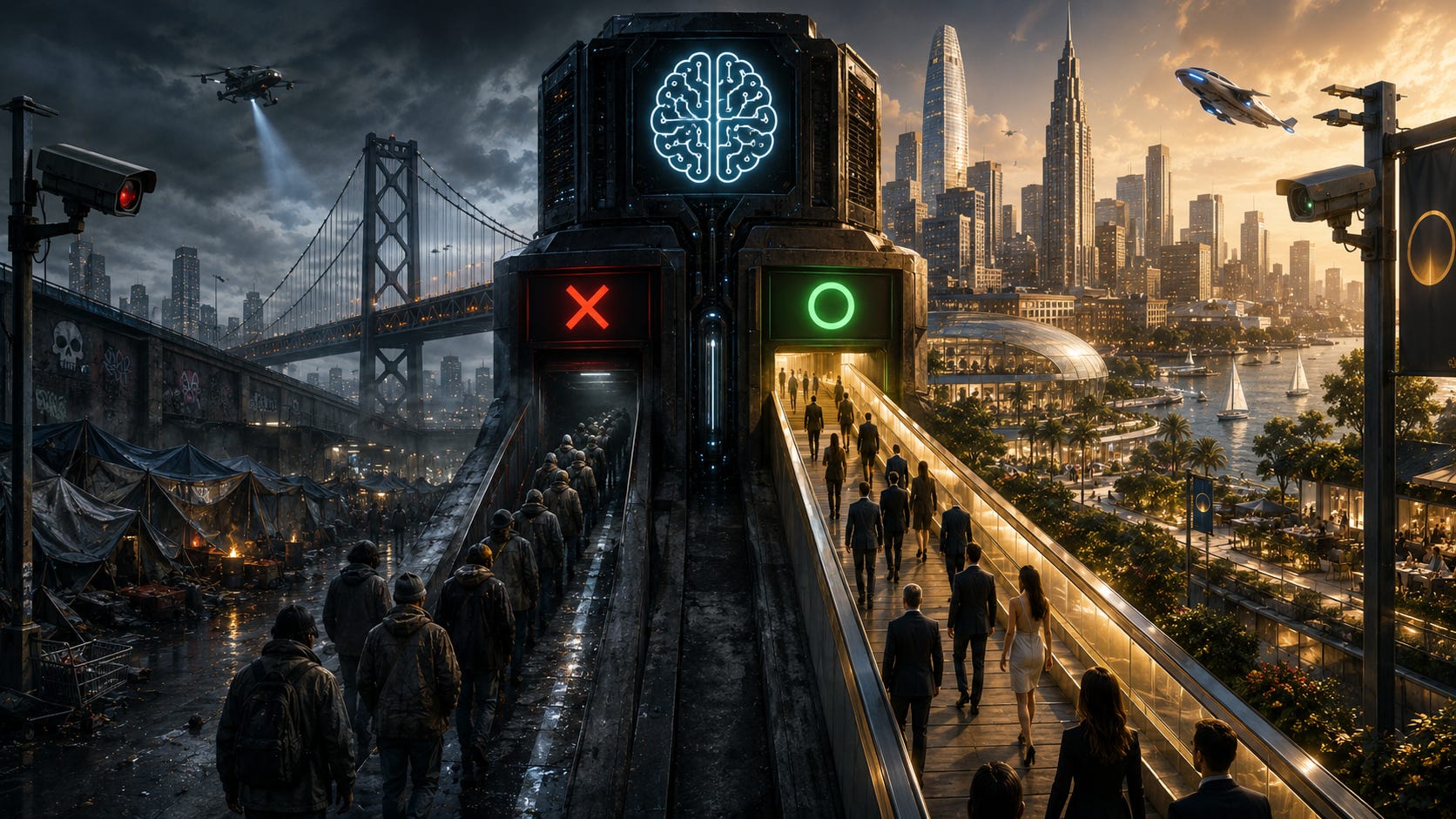
Living in Silicon Valley has always warped people’s sense of how much money is enough. No doubt it’s a high cost of living city. But lately, the expectation amongst the highest earners in tech is no longer about what's enough to retire: it's about how to survive.
What they're trying to survive is the permanent underclass. The emerging idea goes like this: once artificial intelligence gets good enough to fully replace human labor, class positions will freeze and the rich will deploy super-intelligent machines. Everyone else waits for welfare or battles it out for a slice of bread in an apocalyptic wasteland.
There are some clear flaws in this prediction. But that hasn't stopped the permanent underclass rhetoric from spreading amongst almost everyone in Silicon Valley I've talked to over the last few months. It usually first comes up as a joke, until I realize that they recently pushed themselves to work harder than they ever have. They are undoubtedly convinced that even if there's only a small chance it's true, there are just a few years left to earn their way into the elite before AGI hits.
When I asked around about how much it takes to escape the permanent underclass, around $10 million seems to be the minimum. Another friend told me $50 million in order to make sure his siblings and parents each had their own homes to escape as well. One friend said $20+ million because Alpha School, the AI native academy for kids, currently costs $75K+/year.
Every mania San Francisco has run on, the gold rush, the dot-com boom, crypto, all promised the same thing: get in now or miss out forever. The permanent underclass story is the first one running in the opposite direction, the fear of being locked into permanent damnation.
In 1905, a German sociologist named Max Weber looked at Calvinism and formulated a theory of how it produced the most disciplined, anxious, and capitalistic people in Europe. Calvinists believed in predestination: before the world was created, God had sovereignly sorted everyone into the saved and the damned. Weber’s contested that because individuals could not earn their way into heaven, believers experienced immense anxiety about their eternal fate. To help them cope, religious leaders taught that relentless, diligent work in one's earthly occupation was a religious duty. A life of visible discipline became the tell that you might be one of the elect.
If Calvinist predestination birthed modern capitalism, then the permanent underclass is Silicon Valley’s secular version. There’s no way to know if you’ll land on the right side of AGI, so you grind to reassure yourself you might. And as with predestination, no amount of work ever settles it. If the floor gives way and stopping means you and your kids fall through forever, then you have a convenient reason to work harder than ever.
Silicon Valley has always been full of ambitious, obsessive, and neurotic people who have transformed the world while building billion-dollar companies. What’s new now is just the story they get to tell about it. If the mission statement isn’t enough, then getting employees to work 996 is a small price to avoid permanent damnation. And for the founder, it's a better story: it reconverts "I can't stop" into "I'm building an ark," where everyone who buys in buys themselves a spot on the ark.
Whatever happens with AGI in the next few years is mostly science fiction we're writing for ourselves. No one knows what's coming and it's a little ridiculous to pretend we do. It just so happens that for the first time, the people building the technology feel it leaving them behind even as they build it. But the feeling of being passed by technology isn't new. If that's what's gotten to you, get in line behind everyone who's felt it since the horse and buggy.
The rest of us can come back to reality and sit with the unknown. If people in Silicon Valley want to imagine a future where they end up oppressed because their last few startups failed before AGI hit, they're welcome to. But if you're grinding to escape the permanent underclass, try diagnosing the feeling first: anxiety, neuroticism, or plain obsession with AI. Or even easier, just tell people that you love the work.