
Why Duplexes Sell for Less Than Houses in San Francisco
It's rent control duh

In 2026, housing prices in San Francisco have soared as the AI boom has brought billions into the city’s housing market. Single-family homes (SFH) have been the default winner with median sale prices at around $2.2 million. Duplexes are likely the next trickle-down winner in this space.
The standard case for a duplex is the rent: live in one unit, rent the other, and let a tenant cover part of the mortgage. But with rent control capping the returns: is it worth buying a duplex to live in instead of a single-family home?
The Vacancy Premium
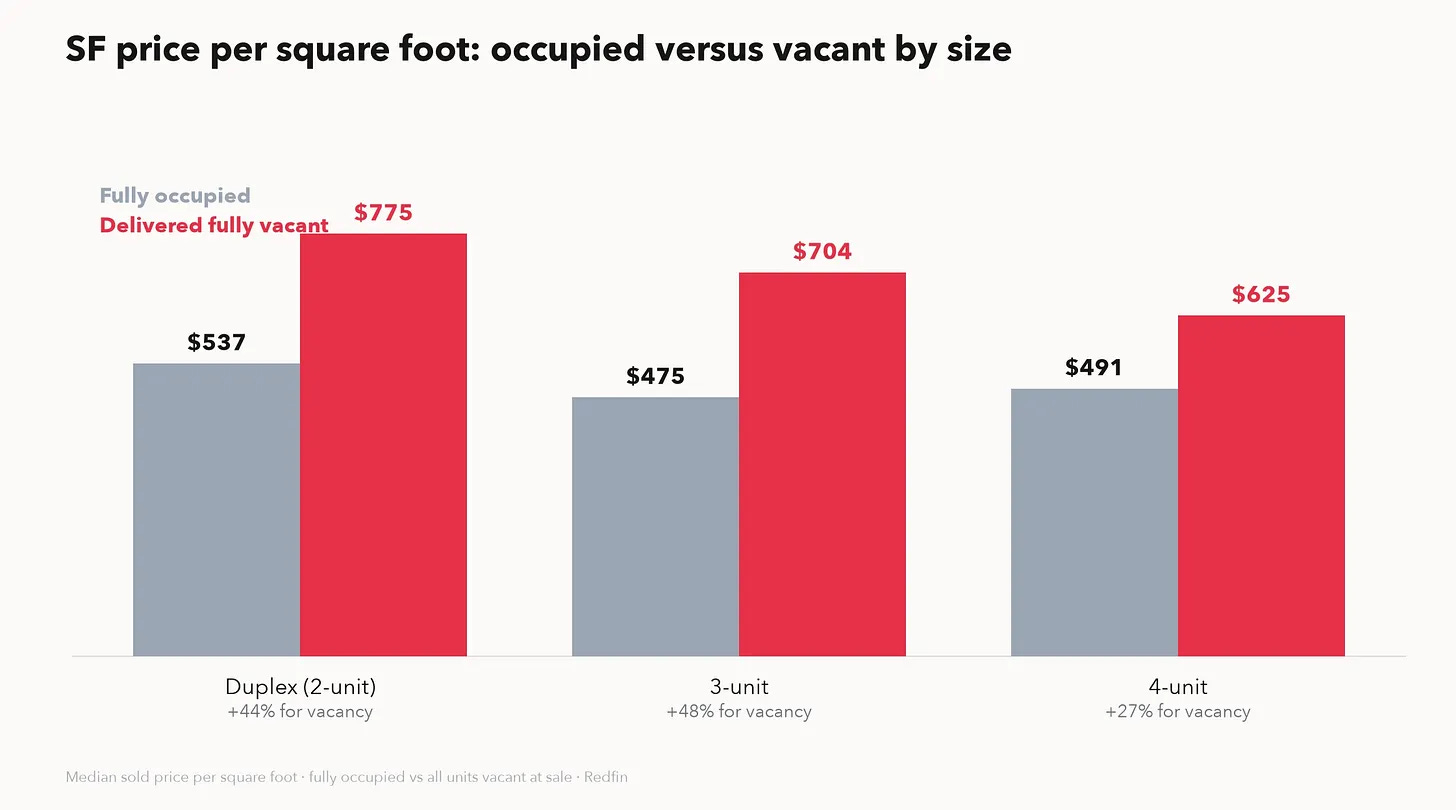
While almost all SFH sell empty, over 50% of duplexes in the last five years have sold with at least one tenant in San Francisco. And looking at five years of duplex sales, a clear pattern emerges: a duplex sold fully vacant fetches about 44% more per square foot than the same building sold with tenants still in it.
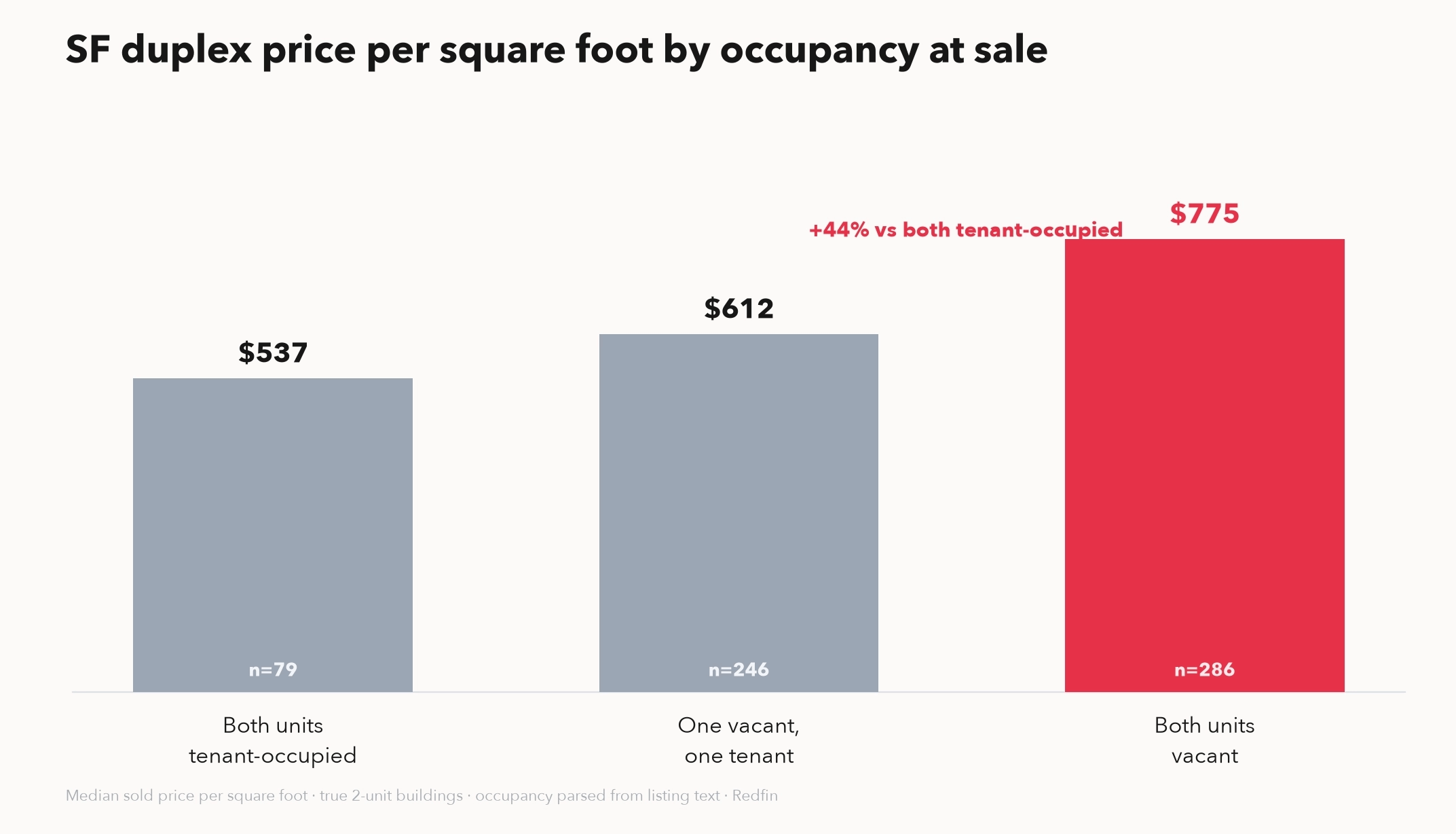
The reason is rent control. A rent-controlled tenant in San Francisco is as close to a permanent owner as possible. And while rent control does not apply to SFH, it applies broadly to any duplex or multi-unit building built before 1979.
Tenancy commonly complicates any future sale or move-in and caps the growth of rental income to 60% of the CPI. And while rent control was written to protect tenants, in the resale market it has made removing them the single most valuable thing an owner can do, especially when a sitting tenant pays ~42% below a new lease on the same unit1
.
The Functional Merger
Historically single-family homes have commanded higher prices than duplexes due to the premium buyers pay for total land ownership, greater privacy, and higher historical appreciation rates. Homes in San Francisco are 25% more expensive than duplexes on a price per square footage ($/sqft) basis and 18% higher than duplexes when controlled for tenancy, size, and renovation2.
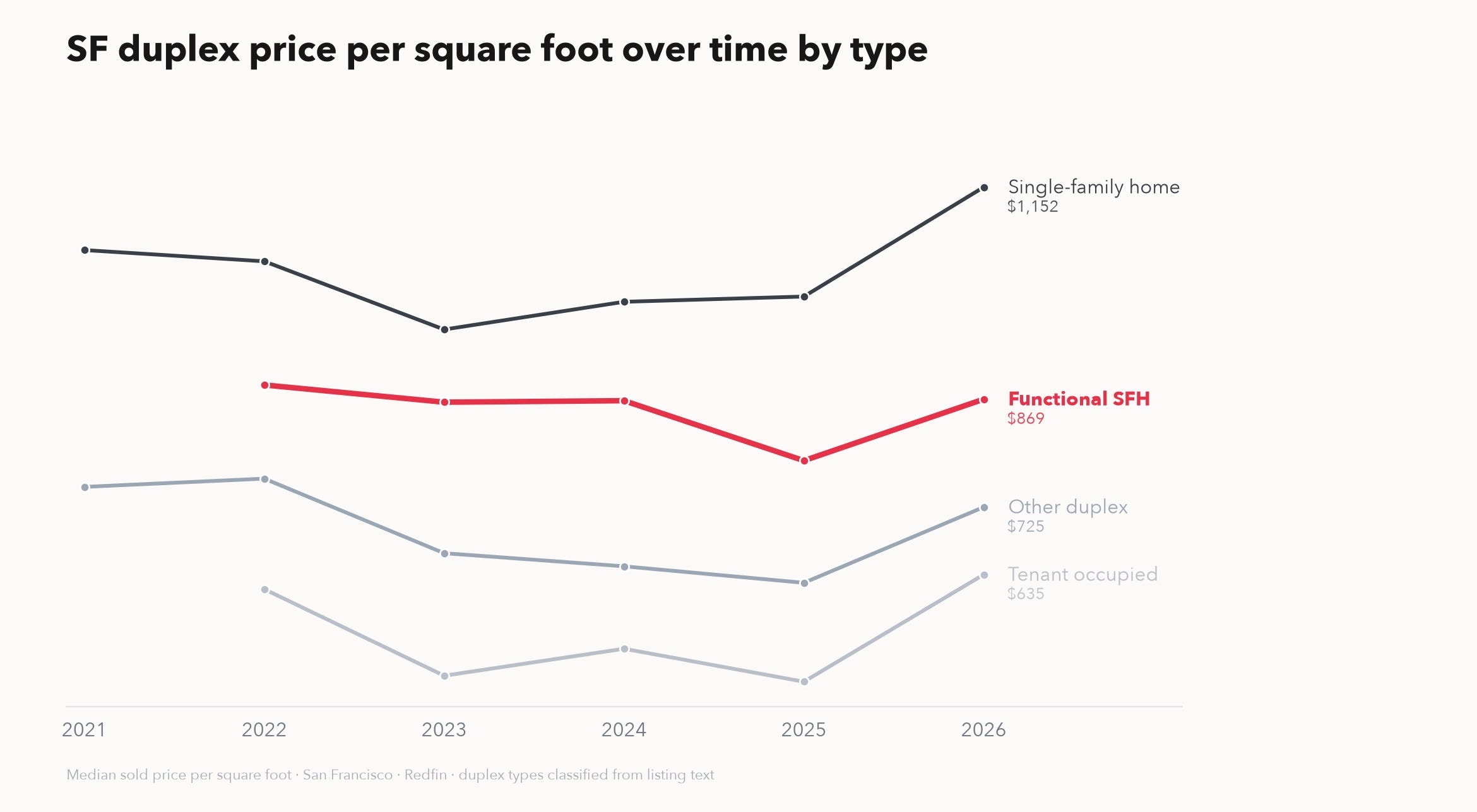
So why not just merge the duplex into a house? Merger approvals are incredibly rare to completely illegal (and they’ll even make you unmerge your home). A legal merger removes a rental unit from the housing stock and San Francisco resists reducing housing inventory of any kind.
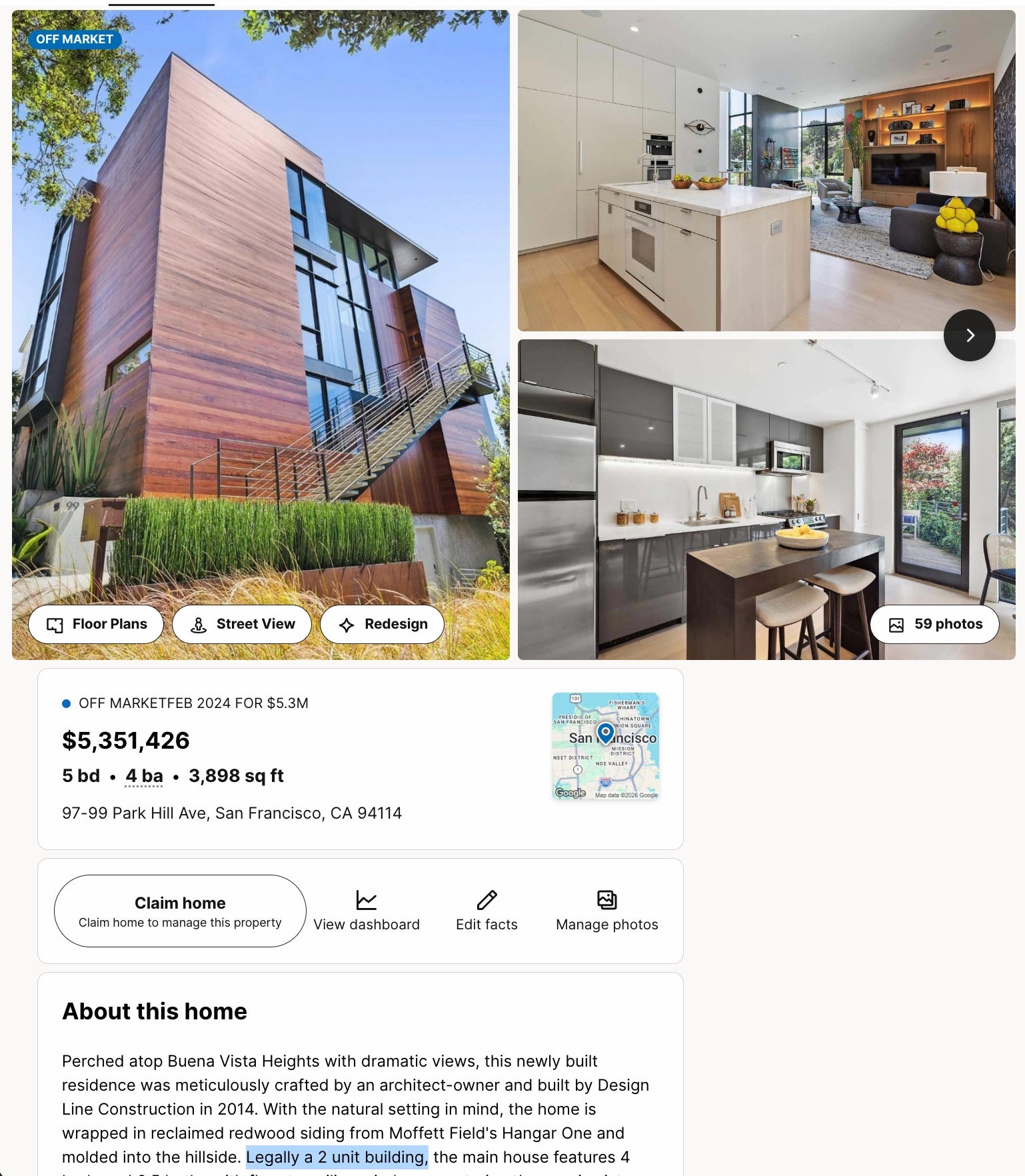
The functional merger path though is wide open. To functionally merge a duplex is to live in it and design it as one house while keeping it legally as two units. Keep a kitchen on each floor, separate entrances for each, and the building stays a duplex on paper.
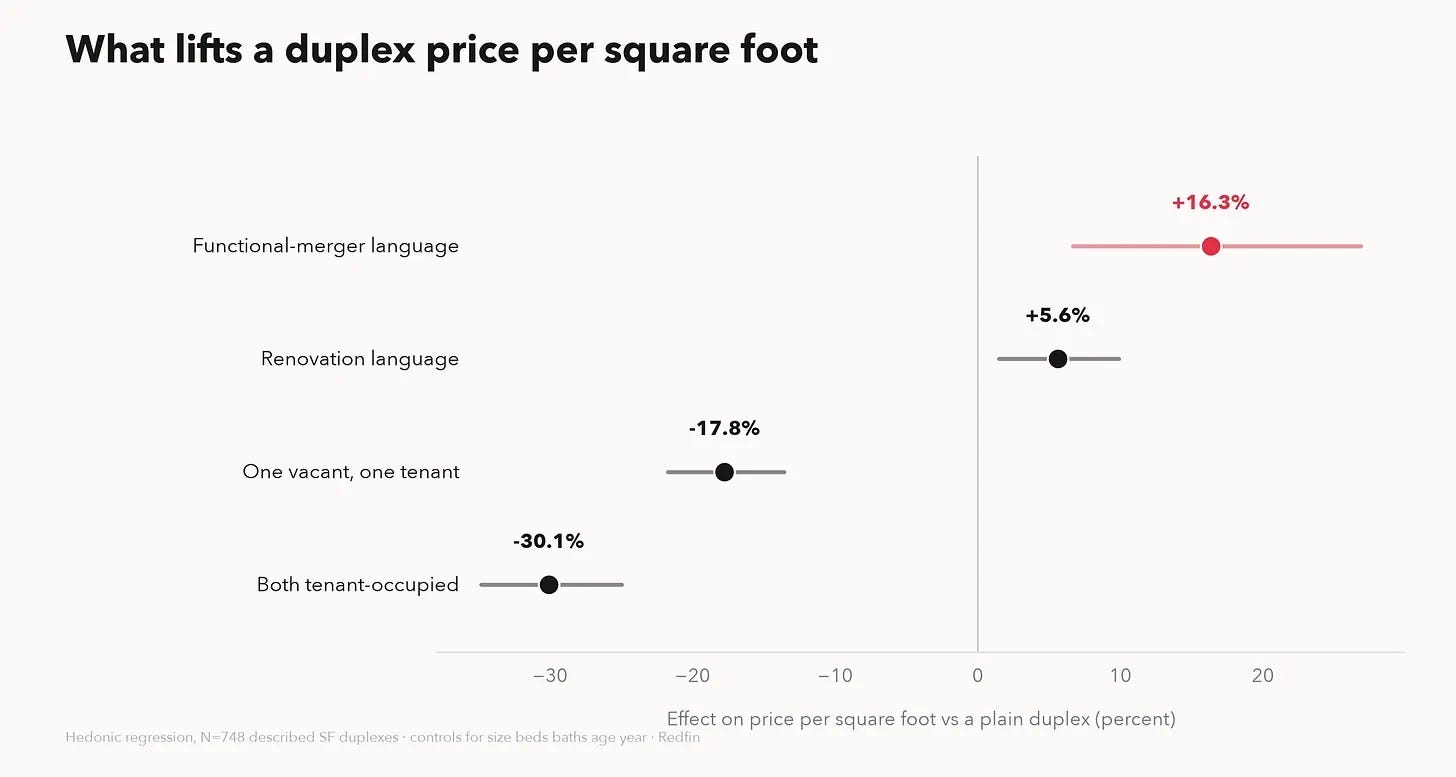
And duplexes marketed with functional-merger language on listings sell at a 16% price-per-square-foot premium over a plain duplex and only 12% lower than a SFH when controlling for factors like tenancy, size, and renovation.
Walk through these listings online, and you'll see a recurring pattern: a state-of-the-art chef's kitchen on the main floor, and a humble, untouched kitchenette tucked away upstairs to keep the duplex status legally intact. The duplex will hold more bedrooms on the top floor and more communal living areas on the bottom. And legally, you can build a connected staircase between the two as long as there is a door for separation.
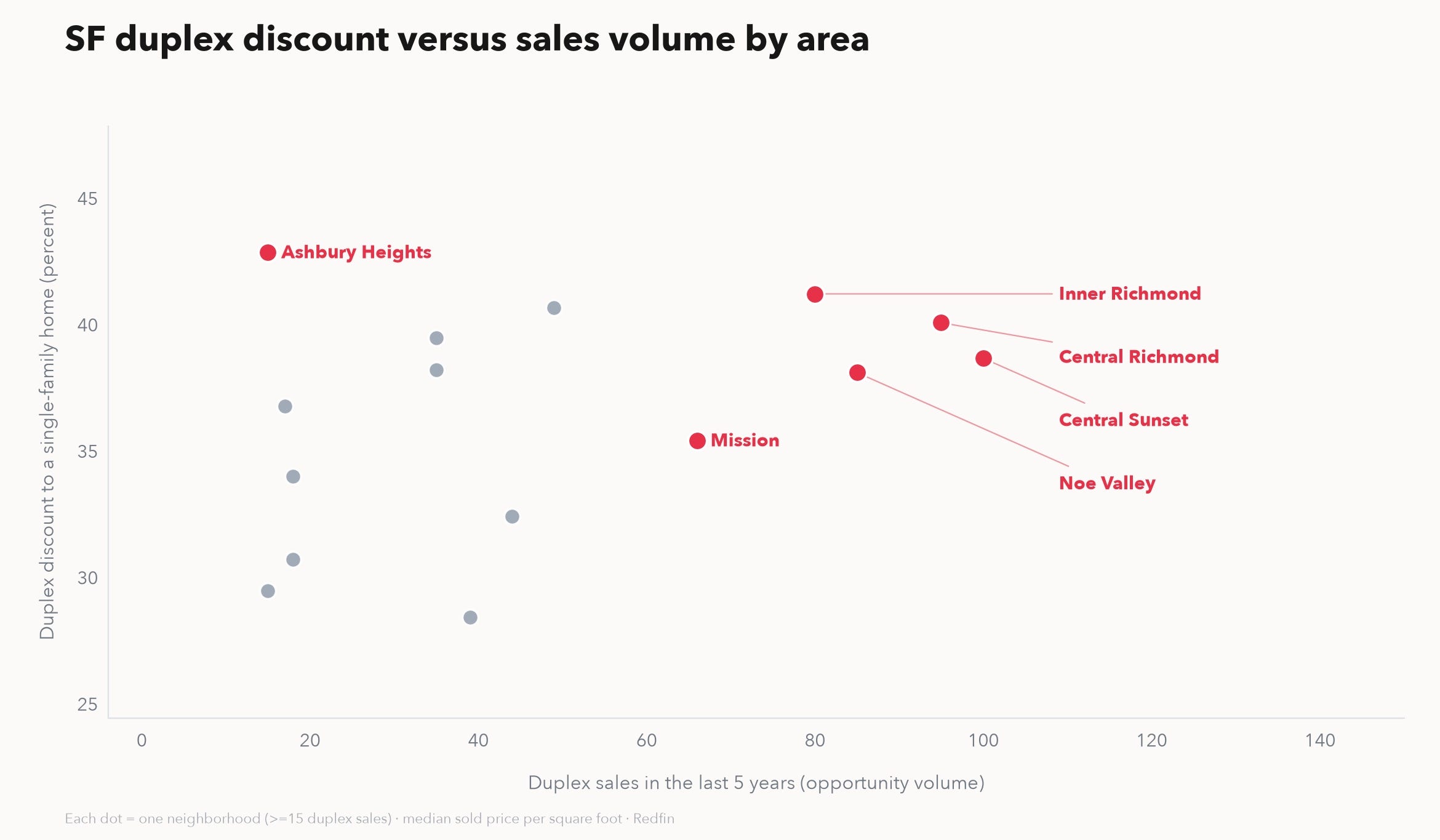
On average, the SFH sells for a higher premium over duplexes of any kind. But as new home development goes flat in the city for the next few decades, potential buyers priced out of SFH are likely to move to the next best opportunity.
Will SF Ever Clamp Down?
San Francisco’s housing policy however has one consistent instinct: stop units from leaving the rental stock rather than building new ones. And functional mergers converting duplexes to SFH are likely looked down upon when it comes to reducing inventory.
But the city has not given many other choices. Historically condo conversion was a profitable and non-housing reduction route for duplex owners to flip units through renovation. But the city shut the door on conversion of rental stock to owner-occupied housing in 2013 through the suspension of the conversion lottery. The only way to convert now is through the tenancy-in-common path, where two or more unrelated owners each live in a unit for at least a year before converting to condos. In practice that means couples buying before marriage or friends buying a multi-family together.
In 2022, San Francisco voters passed Proposition M, the Empty Homes Tax, the most aggressive vacancy penalty the city had ever attempted. The law was meant to penalize owners of residential buildings with three or more units if they were vacant more than half the year. In October 2024, a Superior Court judge struck it down as unconstitutional, with the core claim that the proposition was preempted by the Ellis Act. Simply stated, a city cannot force an owner to rent out their property.
Other cities are trying the same thing and hitting the same wall. On July 1st, 2026, New York City’s pied-à-terre tax took effect, a surcharge on high-value homes that are not the owner’s primary residence. This measure is projected to raise around $500 million a year. But even this tax is assessed per tax lot and any property that serves as the owner’s primary residence is exempt in full. A duplex where the owner lives across both floors is assessed as one primary residence.
Conclusion
As homes continue to become a scarcer asset in San Francisco, the shift towards duplexes will start accelerating as functional SFH become more and more popular. Neighborhoods like the Richmond, Sunset, Noe Valley, and Mission all boast high rates of duplex housing along with a high discount on a $/sqft basis compared to SFH.
If you empty both units and present the duplex as a home: you capture most of a single-family house without ever building or buying one. Even Aaron Peskin, a progressive power broker who spent decades fighting new housing and once wrote legislation to curb exactly these mergers, was discovered to live in this kind of duplex that the city eventually walked through and cleared as legal.
San Francisco could decide to build new housing or incentivize landlords toward renting but so far hasn’t done either. Until it does, the duplex that empties out and lives like a house will win in the near future.
Analysis of the San Francisco Rent Board Housing Inventory (2025 filings; 116,204 tenant-occupied records). For each bedroom size, the average rent of tenants who moved in 10 or more years ago (the entrenched, rent-controlled cohort) is compared against leases signed in the prior 12 months, which reflect the current market rate for the same unit type. Long-tenured tenants pay roughly 42% less: 1BR $1,657 vs $2,866, 2BR $2,123 vs $3,703, 3BR $2,528 vs $4,306 (a 42%, 43%, and 41% discount respectively). Rents are midpoints of the Rent Board’s banded rent field, which tops out at $6,000 and therefore understates the true market ceiling, making 42% a conservative floor. Measured against current open-market asking rents (Zumper, July 2026: roughly $4,000, $5,850, and $7,000 for 1BR, 2BR, and 3BR), the same tenants pay 55-65% below market.
Analysis of Redfin sold listings in San Francisco, 2021-2026 (8,085 single-family homes and 950 two-unit buildings). On raw median price per square foot, single-family homes ($1,029) sell about 25% above a fully vacant duplex ($775), the fair comparison since both are deliverable for owner occupancy; measured against all duplexes regardless of tenancy the raw gap widens to 33%. Holding the duplex fully vacant and controlling for building size, bedrooms, bathrooms, age, neighborhood, and sale year, a duplex still sells about 18% below a comparable single-family home (hedonic regression, p<0.001). Renovation is controlled within the duplex sample elsewhere in this analysis but is not observable for single-family homes, so it is excluded from this cross-type comparison.